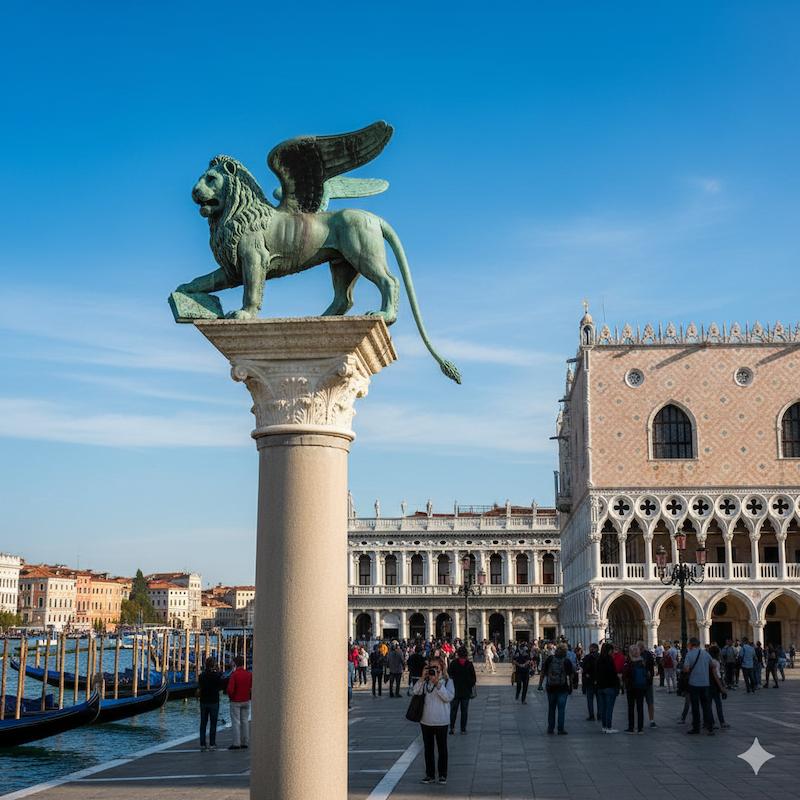
In Venice, lions are everywhere—carved above doors, standing guard in squares, painted on walls, and sculpted into columns. To most visitors, they appear as decorative emblems. In reality, the Venetian lion is a coded symbol of authority, surveillance, and ideological control that shaped the Republic for centuries.
To truly understand this visual language, our Venice guided tours often decode the city’s symbols, revealing how power was communicated silently through architecture and sculpture.
The Lion of Saint Mark: A Political Weapon
The winged lion represents Saint Mark the Evangelist, Venice’s patron saint. But beyond religion, it became the Republic’s most effective political symbol.
Displaying the lion signaled:
-
Venetian jurisdiction
-
Loyalty to the Republic
-
Legal and military authority
Where the lion stood, Venice ruled.
Open Book or Closed Book: A Silent Message
One of the most overlooked details is whether the lion holds an open or closed book.
-
An open book symbolized peace and lawful governance
-
A closed book often appeared during wartime or in contested territories
This was a visual language instantly understood by contemporaries.
Lions as Watchers
Many Venetian lions are positioned high above eye level, facing outward. This placement was deliberate. Lions acted as silent observers, reminding citizens and visitors alike that the Republic was always watching.
In a city built on control of movement and trade, symbolism replaced force.
Lions Marking Borders and Power
Lions appear frequently at:
-
Former customs points
-
Bridges and entrances
-
Administrative buildings
-
Colonies once ruled by Venice
They functioned as territorial markers, much like flags today.
Altered and Defaced Lions
In periods of political upheaval, invading powers often damaged or removed Venetian lions. Faces were chipped away, wings broken, books erased.
These acts were not vandalism—they were deliberate attempts to erase Venetian authority.
Different Styles, Different Meanings
Not all lions look the same. Some are fierce, others calm, some almost human. These variations reflect:
-
Different political eras
-
Local interpretations
-
Intended emotional impact
Even style was part of the message.
Why Lions Still Matter Today
The lion remains Venice’s most enduring symbol because it embodies:
-
Faith and governance
-
Power without noise
-
Control through imagery
It explains how Venice ruled a vast maritime empire without walls or armies on land.
Final Thoughts
Venice’s lions are not decorative relics—they are stone messengers of a vanished empire. Once you understand their meaning, the city reveals itself as a place where symbols replaced swords and architecture became law.
From that moment on, every lion you pass will seem to be watching you back.