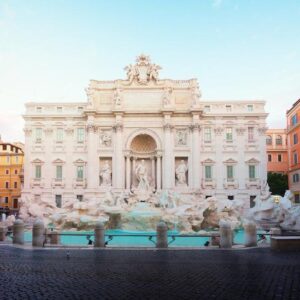
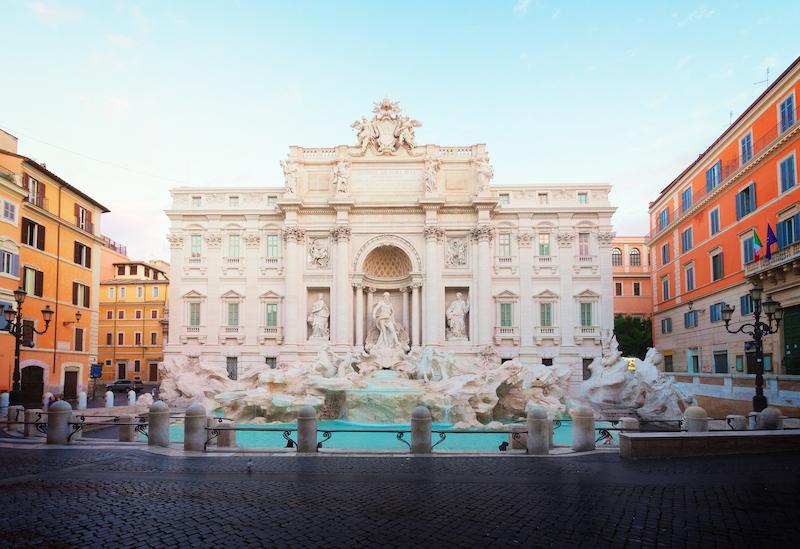
The Trevi Fountain is Rome’s largest Baroque fountain, completed in 1762, and the coin legend says that tossing one over your shoulder guarantees your return to Rome. That’s the version everyone knows. The fuller story — who built it, why it faces the way it does, what the figures actually represent, and where the roughly €3,000 thrown in every day goes — is more interesting, and it’s what this guide is about.
A Fountain at the End of an Aqueduct
The Trevi Fountain isn’t just a monument; it’s the endpoint of an ancient piece of infrastructure.
It marks the terminus of the Aqua Virgo, an aqueduct commissioned by Agrippa in 19 BC to supply water to the baths of ancient Rome — and one that, remarkably, still feeds the fountain today. The name “Trevi” is generally traced to the Latin trivium, the meeting of three roads at this point in the city.
So before it was Baroque, it was Roman. The fountain you photograph sits on two thousand years of continuous water supply, which is a rarer thing than the crowd in front of it suggests.
Who Built It
The design most people picture is the work of architect Nicola Salvi, and it was completed by Giuseppe Pannini in 1762 — decades after Salvi’s death. It’s a masterpiece of Baroque art, built against the back wall of the Palazzo Poli, which is why the fountain and the palace read as a single theatrical facade.
That theatrical quality is the point. The Baroque aimed to overwhelm, and the Trevi does: it’s designed to be come upon suddenly, in a small piazza, at a scale the square can barely contain.
Reading the Statues
Most visitors see a crowd of figures and water. Here’s what they actually depict.
At the centre stands Oceanus, god of all water — not Neptune, as is often assumed — riding a shell-shaped chariot. The chariot is pulled by two sea horses, each led by a Triton, and the two horses are deliberately different: one calm, one wild, representing the two moods of the sea. It’s a single idea carved into the whole composition — water as both serene and violent.
Above, allegorical figures and reliefs tell the story of the Aqua Virgo’s origins, including the legend of the young girl who, according to tradition, showed Roman soldiers the location of the spring that fed the aqueduct — the “virgin” that gives the Aqua Virgo its name.
The Legend of the Coin
Now the part everyone comes for.
The tradition: with your back to the fountain, toss a coin over your left shoulder with your right hand, and you’re guaranteed to return to Rome one day.
There’s a more elaborate three-coin version that grew up alongside it: the first coin ensures your return to Rome, the second a new romance, the third marriage. It’s a later embellishment, but it’s the one you’ll hear from guides.
The scale of the tradition is genuinely striking. Around €3,000 is thrown into the fountain every single day — collected each morning by the city. And the money isn’t kept: it’s donated to charity, historically funding a subsidised supermarket and other social projects run by the Italian Red Cross. The wish you toss in pays for someone’s groceries, which is a nicer ending than the legend promises.
The fountain owes much of its global fame to a single scene: Anita Ekberg wading into the water in Fellini’s La Dolce Vita (1960), which fixed the Trevi in the world’s imagination as the romantic heart of Rome.
The Rules Nobody Tells You
The coin toss is charming. The logistics, less so — and knowing them beforehand saves the visit.
- You cannot enter the water. Wading in — Ekberg notwithstanding — results in a fine. The Fellini scene is not a re-enactable experience.
- Taking coins out is illegal. The daily collection is a city operation; removing coins yourself is theft and is treated as such.
- The crowds are relentless. The small piazza concentrates visitors, and from mid-morning to evening it is genuinely packed.
- Access may be managed. The city has been trialling measures to control crowding at the fountain, including limits on how many people can approach the basin at once. Arrangements change, so check locally.
When to Actually Go
Early morning is the only reliable answer — around dawn, or shortly after. The light is better, the crowd is a fraction of its daytime size, and you can actually see the fountain rather than the backs of other visitors’ phones.
Late at night is the second-best option; the fountain is lit and the atmosphere is worth the lost sleep. Midday to early evening is the worst — maximum crowd, harshest light.
The Trevi sits in one of Rome’s most walkable areas, steps from the Spanish Steps and the Pantheon. Our guide to the Trevi District covers what else is within a few minutes’ walk — it’s a neighbourhood worth more than the single photograph most people give it.
Fitting It Into a First Visit
The Trevi is free, central, and takes fifteen minutes — which makes it a natural anchor for a first day in Rome rather than a destination in itself. Our Rome in 3 Days itinerary places it on a walking route with the Pantheon and Piazza Navona, which is how it’s best experienced: as one stop in an evening stroll, ideally after the day crowds have thinned.
For a guided walk through the historic centre that ties these sights together with their stories, see our Rome tours.
FAQ
How do you make a wish at the Trevi Fountain?
Stand with your back to the fountain and toss a coin over your left shoulder with your right hand. Tradition says one coin guarantees your return to Rome; a three-coin version adds romance and marriage.
Which way do you throw the coin?
Over your left shoulder, using your right hand, with your back to the fountain.
Where does the Trevi Fountain money go?
The roughly €3,000 collected daily is donated to charity, historically funding social projects run by the Italian Red Cross, including a subsidised supermarket for people in need.
Who is the central statue at the Trevi Fountain?
Oceanus, the god of all water — often mistaken for Neptune. He rides a shell-shaped chariot pulled by two sea horses, one calm and one wild.
When was the Trevi Fountain built?
It was designed by Nicola Salvi and completed by Giuseppe Pannini in 1762, in the Baroque style, at the terminus of the ancient Aqua Virgo aqueduct.
Can you go in the Trevi Fountain?
No. Entering the water results in a fine, and removing coins is illegal. The famous La Dolce Vita scene cannot be re-enacted.
What’s the best time to visit the Trevi Fountain?
Early morning, around dawn, for the smallest crowds and the best light. Late evening, when the fountain is lit, is the second-best option. Avoid midday to early evening.