
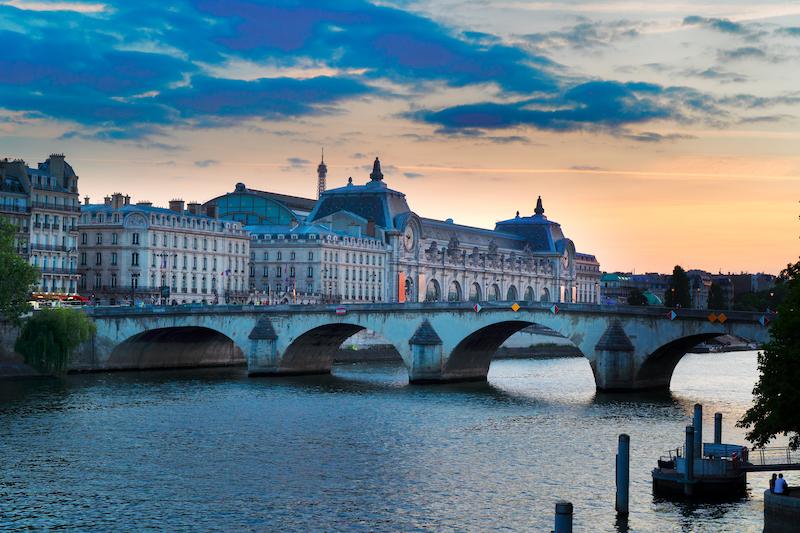
If you have one museum day in Paris, visit the Musée d’Orsay. If you have two, do the Louvre first. That sounds backwards, and it isn’t: the Orsay is the better experience for most visitors, while the Louvre is the one you’ll regret skipping. Which order you use depends on how many days you have. Here’s the reasoning.
The Fundamental Difference
These are not two versions of the same museum.
The Louvre is a universal collection. Ancient Egypt, Mesopotamia, Greek and Roman sculpture, Islamic art, European painting from the medieval period to about 1848. It is one of the largest art collections in the world, housed in a former royal palace, and it is not designed to be seen in a single visit.
The Musée d’Orsay is a period collection. It picks up roughly where the Louvre stops — 1848 to 1914 — and covers Impressionism and Post-Impressionism: Monet, Renoir, Manet, Degas, Van Gogh, Cézanne. It is housed in a former railway station, and the building itself is part of the appeal.
The practical consequence: the Louvre is a museum you sample. The Orsay is a museum you can actually finish.
Side by Side
| Louvre | Musée d’Orsay | |
| Collection | Antiquity to 1848, global | 1848–1914, mostly French |
| Famous for | Mona Lisa, Venus de Milo, Winged Victory | Impressionists and Post-Impressionists |
| Building | Former royal palace | Former railway station (1900) |
| Realistic visit | 3 hours minimum, could be days | 2 to 2.5 hours |
| Can you see it all? | No | Broadly, yes |
| Crowds | Heavy, concentrated in specific rooms | Heavy but better distributed |
| Best for | Breadth, scale, the icons | Coherence, a satisfying visit |
Why Most People Enjoy the Orsay More
This is the part that first-time visitors rarely hear before booking.
The Louvre is overwhelming by design — it was a palace before it was a museum, and the scale that made it a statement of royal power makes it exhausting as an art venue. Visitors routinely spend forty minutes navigating to the Mona Lisa, find it small and behind glass at a distance, and leave with the sense that they’ve done something obligatory rather than something enjoyable.
The Orsay is the opposite. It’s a single large hall with galleries off it, the collection has a clear narrative arc, the works are famous without being mobbed in the same way, and the top-floor Impressionist rooms have natural light and views over the Seine through the station’s original clock face.
Two and a half hours in the Orsay leaves most people satisfied. Three hours in the Louvre leaves most people tired.
Why You Should Still Do the Louvre
Because it holds things that exist nowhere else, and because “I was in Paris and didn’t go to the Louvre” is a sentence most travellers don’t want to say.
The Venus de Milo, the Winged Victory of Samothrace, the Egyptian collection, the Napoleon apartments — these are not consolation prizes for missing the Mona Lisa. They’re the reason to go, and they’re substantially less crowded than the one painting everyone queues for.
Go to the Louvre for what isn’t famous. That’s where it stops being a chore.
The Order, Depending on Your Trip
One museum only
Musée d’Orsay. Better experience, more manageable, and the Impressionist collection is the strongest single-period holding in the city. Unless a specific Louvre work is the reason you’re in Paris, this is the choice.
Two days, one museum each
Louvre first, Orsay second. Do the harder museum while you have energy, and let the Orsay be the more pleasant second visit. Doing it the other way round means the Louvre becomes the tiring end to your trip.
Both in one day
Possible, not advisable. They sit on opposite banks about fifteen minutes’ walk apart, so the logistics work. What doesn’t work is the fatigue: five to six hours of museum in a day produces diminishing returns fast. If you must, do the Louvre in the morning (three hours, no more), break properly for lunch, and give the Orsay the afternoon.
Travelling with children
Orsay. Shorter, more legible, and the building is interesting in itself. The Louvre with children under ten is a long walk punctuated by art.
Practical Notes for Both
- Book timed entry. For both museums. It’s the single largest time saving available.
- Both are closed one day a week, and it isn’t the same day — check before building your itinerary around either.
- Free entry days exist but are the busiest of the month; on national holidays such as July 14, major museums including the Louvre and the Orsay often offer free admission, which is worth knowing and generally worth avoiding if crowds bother you.
- The Cour Carrée — the Louvre’s inner courtyard — is usually calm compared to the pyramid entrance, and a good place to regroup.
- Neither museum requires a full day, whatever the guidebooks suggest. Three hours at the Louvre with a plan beats six without one.
Fitting Them Into a Short Trip
Both sit on the Seine, which makes them natural anchors for a walking route rather than isolated stops. Even if you don’t go inside, the view of the Louvre from the Pont Royal or the Jardin des Tuileries is worth the detour — and the Orsay is directly across the river. Our guide to walking along the Seine covers the route that connects them.
On a two-day trip, the Louvre belongs to the Right Bank day. Our two-day Paris itinerary places it there, with the Orsay as one of the afternoon alternatives.
For a broader view of what to prioritise on a first visit, see our guide to the best things to do in Paris for first-time visitors. And for the tours available in the city, see our Paris tours.
FAQ
Is the Louvre or the Musée d’Orsay better?
The Orsay is the better experience for most visitors — it’s more manageable and can be seen properly in one visit. The Louvre holds more, including works that exist nowhere else, but it can’t be seen in a single visit and often leaves people exhausted rather than satisfied.
Which should I visit first?
If you’re only visiting one, the Orsay. If you’re visiting both on separate days, do the Louvre first while you have energy.
Can you visit the Louvre and the Musée d’Orsay in one day?
Logistically yes — they’re about fifteen minutes’ walk apart. But five to six hours of museum in a day is exhausting, and most people stop absorbing anything after the first three.
How long do you need at the Louvre?
Three hours is the practical minimum for a visit that covers the highlights and one wing. Seeing the whole collection is not realistic in a day.
How long do you need at the Musée d’Orsay?
Two to two and a half hours is enough to see the collection properly, including the top-floor Impressionist galleries.
Do I need to book tickets in advance?
Yes, for both. Timed entry is the most effective way to avoid the entrance queues, which are the longest single delay at either museum.
Which is better with children?
The Orsay — it’s shorter, the collection is easier to follow, and the former railway station is interesting to look at in itself.