Located between Via Sistina and Via Gregoriana, Palazzo Zuccari, despite the modifications and extensions that have taken place over the past centuries, still reflects the talent and creative flair of its creator, the painter Federico Zuccari, who designed it as his home and studio in the last decade of the 16th century on the remains of the ancient gardens of Lucullus.
You all know the steps leading from the Spanish Steps to Trinità dei Monti, but perhaps not everyone knows that at the top of those steps, between Via Sistina and Via Gregoriana, stands Palazzo Zuccari. This building is most famous for the decorations on one of its facades, but there is much more inside.
Are you interested in discovering hidden gems in Rome? Try our Best of Rome Private Tour
The history of Palazzo Zuccari
Let’s start with a bit of history: Palazzo Zuccari was built in 1590 by Federico Zuccari as his home and studio, with the idea of creating a sumptuous home that would reflect his creative personality. Originally, the palace consisted of three separate areas: the studio, the garden and the private residence, but over the following centuries, it underwent numerous extensions and renovations.
After Zuccari’s death, the palazzo was sold and extended in height with the construction of two floors. In 1702 it was leased to the Queen of Poland, who modified the main facade overlooking Trinità dei Monti by building a portico with six columns. The palace became a cultural center of the 18th century in Rome and it continued to be a home for artists in the following years, hosting people like Winckelmann. In 1756, part of the complex was given to the Brothers of the Christian Schools who made it into a school. This was until 1904 when Palazzo Zuccari was bought by Henriette Hertz who made a further change, constructing a three-story building instead of the garden. It is thanks to her that after her death the Hertziana Library was built inside the palace.
Why it is also called the House of Monsters?
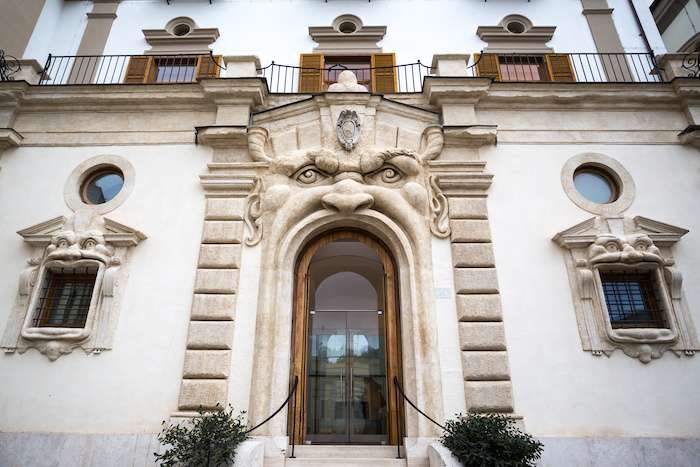
The most characteristic feature of Palazzo Zuccari, and the one that immediately catches the eye, is the large doorway and windows on the facade on Via Gregoriana, which is why the palace has been renamed the House of Monsters. These somewhat unusual decorations were commissioned by Zuccari himself, who had them built to impress his guests. At the time they were the entrance to the garden and were meant to intimidate the visitor and create a pleasant effect of astonishment in contrast with the paradisiacal beauty of the garden and the interior of the house. Did he succeed? At the time I imagine it had a certain effect and fortunately it is one of the few parts of the building that have remained the same to this day!