Rome is a city that fascinates visitors at every turn. Its millennia-old history, imposing monuments, and hidden corners tell stories of a glorious past. Among the many neighborhoods you can visit during your stay in Rome, the Trevi District stands out for its beauty and unmistakable charm. Located in the historic center of the city, the Trevi District is immediately associated with the famous fountain of the same name, one of the most celebrated in the world. However, this district offers much more, with a series of attractions that deserve to be discovered. In this article, we’ll introduce you to the most important places of interest in the Trevi District, all concentrated within a few meters of each other. After reading this, you’ll know exactly what to visit first during your next stay in the Eternal City!
The Trevi Fountain: An Iconic Symbol
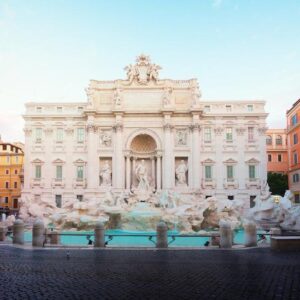
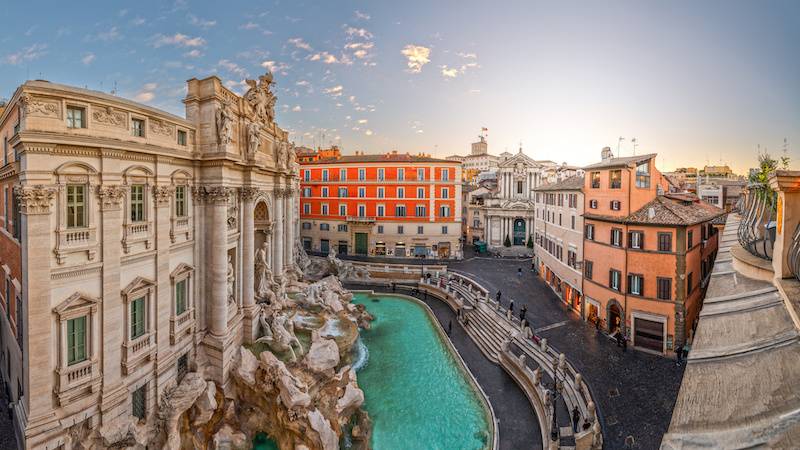
It’s impossible to talk about the Trevi District without mentioning the Trevi Fountain, one of Rome’s undisputed symbols. Designed by the architect Nicola Salvi and completed by Giuseppe Pannini in 1762, the fountain is a masterpiece of Baroque art. With its majestic sculptures representing Neptune, tritons, and other mythological figures, the Trevi Fountain captivates millions of visitors every year. Its definitive consecration worldwide occurred after the much-loved scene with Anita Ekberg and Marcello Mastroianni in Federico Fellini’s famous film “La Dolce Vita”. According to tradition, throwing a coin into the fountain ensures a return to Rome, a gesture that has made this place one of the most Instagrammed and loved in the city, a perfect setting for photo shoots at dawn and dusk.
Curiosities about the Trevi Fountain
- The Legend of the Name “Trevi”: The name “Trevi” might derive from the Latin “trivium,” which means “three streets.” This is because the fountain is located at the intersection of three main roads.
- The 2014 Restoration: The Trevi Fountain underwent significant restoration funded by the fashion house Fendi. The restoration returned the fountain to its former splendor, allowing visitors to admire it in all its glory.
Palazzo Poli: A Dive into Art and Culture
Behind the Trevi Fountain is Palazzo Poli, an elegant building that houses the National Institute for Graphics. This 16th-century palace is an important cultural center where you can admire a vast collection of prints, drawings, and graphic works. Palazzo Poli is not just a place for art conservation but also an exhibition space that organizes temporary exhibitions of great interest.
Church of Saints Vincent and Anastasius at Trevi: A Baroque Jewel
A few steps from the Trevi Fountain is the Church of Saints Vincent and Anastasius at Trevi, another extraordinary example of Baroque architecture. Built in the 17th century, the church is famous for its richly decorated facade and for being the burial place of the viscera of 22 popes. Inside, visitors can admire valuable works of art, including paintings, sculptures, and frescoes that tell the history of the church and its patrons.
The Northern Boundaries of the Trevi District
The northern side of the Trevi District, located just a few meters from Termini Station and Piazza della Repubblica, is full of charming spots. The first is undoubtedly the Church of Santa Susanna, built on the remains of the ancient Roman building from the imperial era (presumably the site of the martyrdom of the saint). Moving towards the Quirinale, we arrive at the famous Piazza del Quirinale, opposite the monumental palace, formerly the seat of popes and kings and today the residence of the President of the Italian Republic. Dominating the adjacent Piazza del Quirinale is an obelisk from the Mausoleum of Augustus, one of the 13 obelisks in Rome, making it the city with the most obelisks in the world.
The Southern Boundaries of the Trevi District
Descending from the Quirinale Hill, you arrive in Piazza Barberini with the beautiful Triton Fountain, built by Gian Lorenzo Bernini commissioned by Pope Urban VIII Barberini. The water that gushed from the fountain came from the Acquedotto Felice. Traveling along Via del Tritone, named after the mentioned fountain, you reach another famous Roman square, Piazza Venezia, a crossroads where five of the city’s most important streets converge: Via dei Fori Imperiali, Via del Corso, Via Nazionale, Corso Vittorio, and Via del Teatro di Marcello. The absolute protagonist of the square is Palazzo Venezia and the monumental complex of the Vittoriano, known as the Altar of the Fatherland, where the Unknown Soldier was buried in 1921. Taking the famous Via del Corso, full of shops and bars, you return to the starting point, the Trevi Fountain.
How to Visit the Trevi District
The Trevi District is easily accessible from any point in Rome. The metro (line A, Barberini stop) is the most convenient way to get there, but it’s also possible to reach the area on foot from the main attractions of the historic center. It is advisable to visit the Trevi Fountain in the early hours of the morning or late evening to avoid the crowds and enjoy a more tranquil and suggestive atmosphere.
Conclusions
The Trevi District is a corner of Rome that never ceases to amaze. Besides the famous fountain, this neighborhood offers a wealth of hidden treasures, history, and culture that deserve to be discovered. A walk through its alleys and squares is a journey through time, an experience that allows you to immerse yourself in the eternal beauty of the Eternal City. Whether you are a first-time visitor or a long-time Roman, the Trevi District always has something new and fascinating to offer.