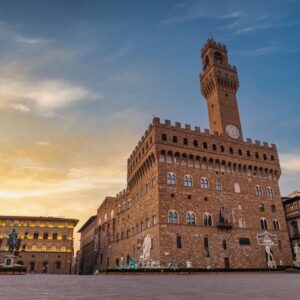
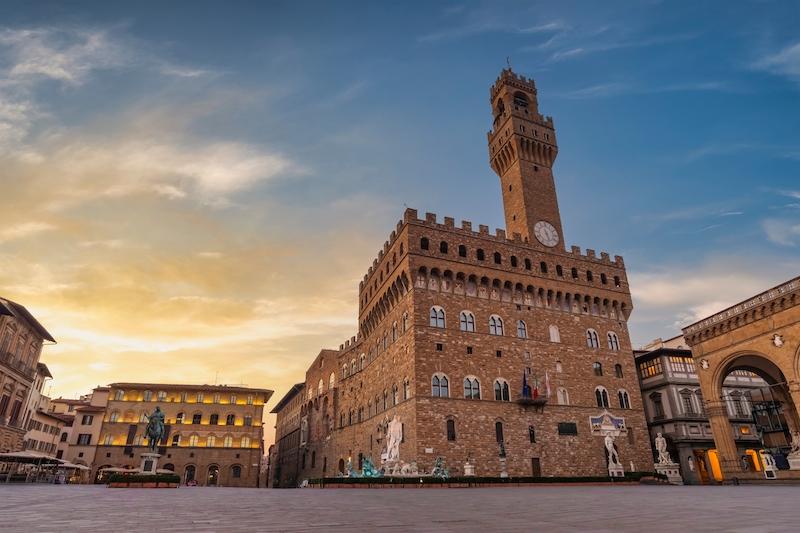
Palazzo Vecchio has been the seat of Florentine power for over 700 years, and behind its public halls runs a network of secret passages the Medici used to move through the building unseen. Most visitors photograph it from Piazza della Signoria and walk on. Inside is one of the most interesting buildings in Florence — a fortress, a town hall, a Medici residence, and a place built with hidden routes for a family that had good reason to watch its back. Here’s what’s inside, and what to look for.
A Fortress Before It Was a Palace
Palazzo Vecchio doesn’t look like a palace, and that’s deliberate. It looks like a fortress — blunt, defensive, topped with battlements and a tower — because when it was built at the turn of the 14th century, Florence’s rulers needed a stronghold as much as a seat of government.
For over 700 years it has been the symbol of the city’s political power, and it remains Florence’s town hall today: the mayor of Florence still works in the building. That continuity is part of what makes it remarkable — this isn’t a museum pretending to be a seat of power. It’s a seat of power that also happens to be a museum.
The name itself tells a story. It’s the Palazzo Vecchio — the “Old Palace” — only because the Medici moved out. When they crossed the river to the Pitti Palace, the building they left behind became the “old” one.
The Medici Takeover
The building’s most dramatic chapter began when Cosimo I de’ Medici made it his residence in the 16th century, turning a republican town hall into a ducal palace.
This is the tension that runs through the whole building, and through Piazza della Signoria outside it. The square was the symbol of the Florentine Republic; the statues in it — Donatello’s Judith, Michelangelo’s David (now a copy) — were charged with republican meaning, expressions of a city that governed itself. Then the Medici took the building, and the republic became a duchy.
You’re looking at the exact place where Florence stopped being a republic. Our guide to Piazza della Signoria covers the statues and their political meanings — read together with the palace, they tell the whole story of that shift.
To make the town hall fit for a duke, Cosimo brought in Giorgio Vasari, who transformed the interior — most spectacularly the vast Salone dei Cinquecento, the Hall of the Five Hundred, built for the republic’s Grand Council and then remade as a monument to Medici glory.
The Secret Passages
Here’s what makes Palazzo Vecchio different from every other grand palace in Florence: it’s riddled with hidden routes.
A ruling family that had seized a republic, made enemies across Italy, and survived assassination attempts did not move through its home in the open. Behind the public halls run concealed passages and staircases, built so the Medici could pass between rooms — and out of the building entirely — without being seen.
- The Studiolo of Francesco I — a small, windowless study hidden off the Salone dei Cinquecento, its entrance concealed. It was a private cabinet of curiosities, and you’d walk past its door without knowing it was there.
- Hidden staircases threaded between the public rooms, allowing movement unseen by petitioners waiting in the halls.
- The connection to the wider escape network — the Medici’s concern with unseen movement is the same instinct that produced the famous elevated corridor linking the palace, across the city and the river, to the Pitti.
These passages are the reason the building rewards a guided visit far more than a wander. From the public rooms they’re invisible; you have to be shown where they are.
The palace’s air of concealment has attracted more than historical interest. Our article on the esoteric symbols of Florence traces the alchemical and astrological motifs carved into Palazzo Vecchio — the sun and moon of cosmic balance, the labyrinth in the courtyard — a different reading of the same secretive building.
The Tower Almost Nobody Climbs
Most visitors climbing something in Florence climb Brunelleschi’s Dome, queue and all. Palazzo Vecchio’s tower — the Torre di Arnolfo — is the one they miss, and it’s the better-value climb.
The view over Florence is excellent, and the ascent is considerably gentler than the Dome’s — a real consideration in a city where the famous climbs are steep, narrow, and crowded. It’s rarely busy, and it puts you above Piazza della Signoria with the Duomo laid out across the rooftops.
One practical note: children under 6 are not permitted up the tower, and access can close in poor weather.
What Else Is Inside
Beyond the passages and the tower, the building holds:
- The Salone dei Cinquecento — the enormous hall, with Vasari’s ceiling and the ongoing mystery of whether a lost Leonardo mural survives behind one of its walls.
- The Museum, which includes an interactive section for children. The Mus.e association runs daily family activities in several languages, bringing the Medici world to life for kids from age 4 — a rare Florence museum that actively works for younger visitors.
- The courtyards and apartments, layered with the decoration of successive rulers.
For families, this makes Palazzo Vecchio one of the most child-friendly major sights in the city — more so than the galleries. Our guide to the best museums for kids in Florence covers the family programme in more detail.
How to Visit
Palazzo Vecchio sits in the centre of everything, on Piazza della Signoria, a few minutes from the Uffizi, the Duomo, and the Ponte Vecchio. It fits naturally into a first day in Florence — our 2-day Florence itinerary places the square and the palace at the heart of day one, between the Duomo and the Uffizi.
To get beyond the public rooms and into the story of the passages, a guided visit is worth it — the building’s history is dense, political, and mostly invisible without someone to point it out. See our Florence tours for guided options through the historic centre.
FAQ
Are there really secret passages in Palazzo Vecchio?
Yes. The building contains concealed staircases and hidden rooms, including the windowless Studiolo of Francesco I off the main hall, built so the Medici could move through the palace unseen.
Why is it called Palazzo Vecchio?
It means “Old Palace.” It got the name when the Medici moved their residence across the river to the Pitti Palace, making this the “old” one.
Can you climb the tower of Palazzo Vecchio?
Yes, and it’s a gentler climb than Brunelleschi’s Dome with an excellent view over Florence. Children under 6 aren’t allowed up, and it can close in bad weather.
Is Palazzo Vecchio worth visiting inside?
Yes — beyond the fortress exterior it holds the vast Salone dei Cinquecento, Vasari’s decoration, the secret passages, and a tower climb. It’s also unusually good for families.
Who lived in Palazzo Vecchio?
It was Florence’s republican town hall, then the residence of Cosimo I de’ Medici in the 16th century, before the family moved to the Pitti Palace. It remains Florence’s town hall today.
Is Palazzo Vecchio good for children?
Unusually so. The museum has an interactive children’s section, and the Mus.e association runs daily family activities in several languages for children from age 4.